
From CNFs to AI-native networks
The shift from virtual network functions (VNFs) to cloud-native network functions (CNFs) was the first big step toward agility. Containerizing network functions made them more portable and scalable, but Kubernetes turned them into a true platform for innovation.
In many telcos, Kubernetes has quietly become the common layer for 5G core and edge workloads, IT applications and BSS/OSS components, and AI/ML pipelines for assurance, optimization, and experience management.
The result: instead of running siloed stacks, operators can start thinking in terms of a unified, programmable platform where networking and AI co-exist.
What the latest CNCF numbers mean for Telcos
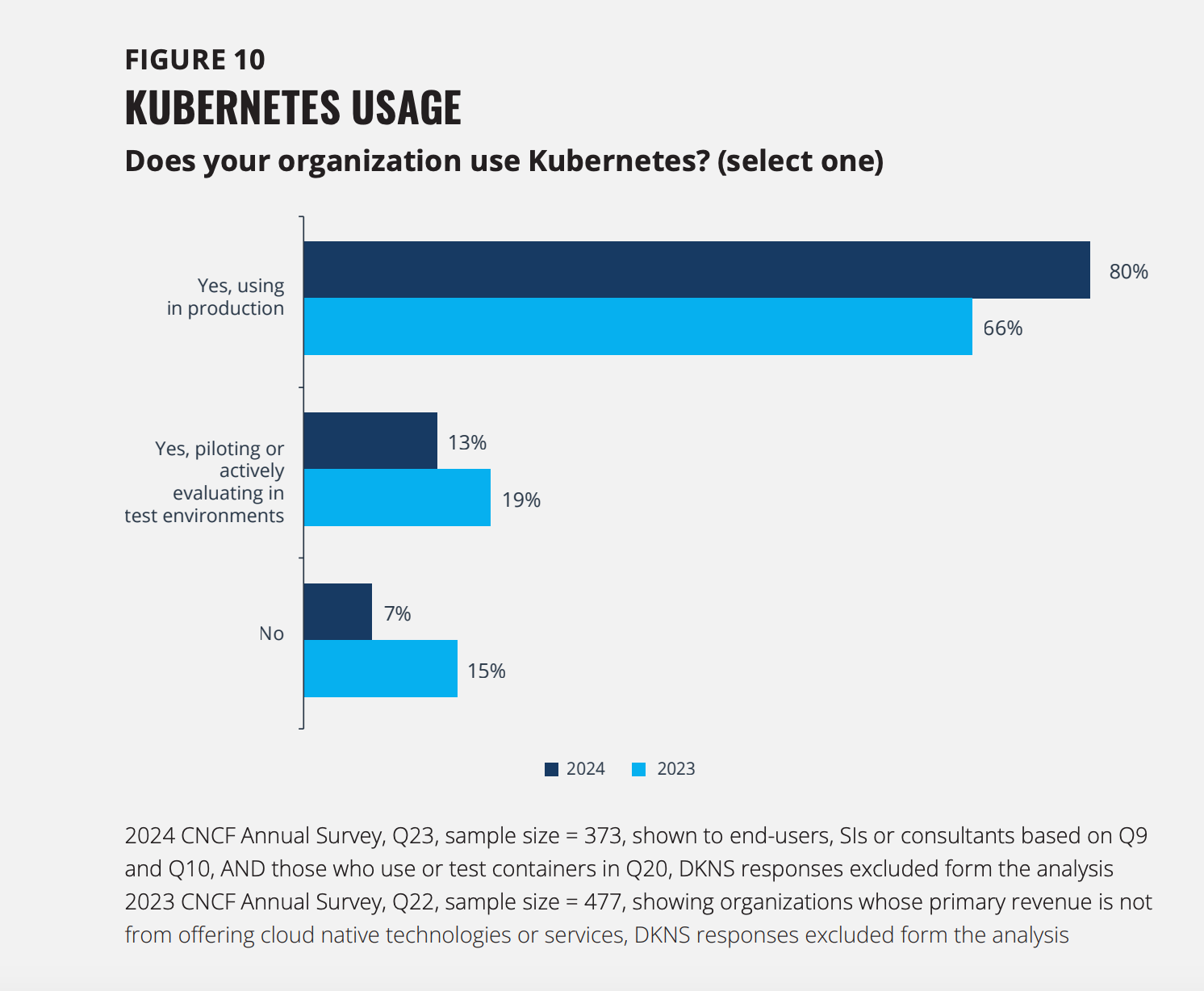
Data from CNCF’s annual survey shows that Kubernetes has become mainstream across industries, with 93% of organizations running Kubernetes in production, piloting it, or actively evaluating it. For telecom operators, the drivers are clear: accelerated 5G deployment, edge and virtualization needs, demand for agility, operational efficiency, and the move away from legacy systems.
Three Kubernetes benefits that matter to telecom leaders
1. Agility and time-to-market
With Kubernetes, telcos can adopt software-native practices like CI/CD, GitOps, and declarative automation across network and IT domains. This means:
- Faster onboarding and lifecycle management for CNFs
- Shorter lead times to launch new products or expose APIs
- The ability to experiment safely in lower environments that mirror production
On LabLabee, we see this reflected in labs that simulate end-to-end workflows: from defining a service in Git, to deploying it on Kubernetes, to observing its behavior in a realistic telco context.
2. Edge and AI enablement
AI in telecom rarely runs in a single data center. Use cases like RAN optimization, video analytics, industrial automation, or low-latency customer experience require intelligence to be distributed across core, edge, and sometimes on-prem.
Kubernetes provides:
- A consistent control plane from central cloud to far edge
- The ability to co-locate network functions and AI workloads
- A platform for GPU-accelerated and data-intensive applications
In practice, this means a data scientist’s model can move from a PoC notebook to a Kubernetes-based pipeline that consumes live network data. LabLabee’s Telco AI labs are designed to simulate exactly these hybrid scenarios: network events feeding into AI pipelines, with learners seeing the impact on service KPIs.
3. Operational efficiency and resilience
Carrier-grade networks demand more than just automation. They need predictable behavior and rapid recovery. Kubernetes contributes with:
- Self-healing capabilities (automatic restart, rescheduling, health checks)
- Horizontal and vertical autoscaling tuned to traffic patterns
- Rich observability that can be integrated with existing NOC/SOC tools
Combined with technologies like eBPF, service mesh, and AI-driven operations, operators can move toward closed-loop automation instead of manual firefighting. LabLabee’s labs are increasingly focused on these “day 2” operations: troubleshooting, observability, and resilience testing on Kubernetes-based telco environments.
Kubernetes as the foundation for AI in telecom
Kubernetes first proved its value in telecom by becoming the platform for cloud-native 5G and edge workloads. It is already used to run network functions, automate deployment at scale, and manage distributed environments across core, far edge, and private infrastructure.
That matters because 5G and edge introduced exactly the kind of operational challenges Kubernetes is good at handling: high availability, scalability, lifecycle management, and consistency across many sites.
That track record is now extending naturally into AI. The same platform that can orchestrate 5G and edge services can also support GPU-based workloads, model serving, and data pipelines.
In telecom, this creates a practical path to deploy AI for network planning and optimization, real-time anomaly detection and root-cause analysis, and more personalized digital experiences. In other words, Kubernetes is no longer only the foundation for cloud-native telecom infrastructure; it is also becoming a credible foundation for AI in telecom.
How LabLabee fits into this evolution
This convergence of AI, cloud-native, and networking is exactly the space where LabLabee operates.
We help telecom operators move from slideware to hands-on proficiency by offering labs that cover CNFs, observability, CI/CD, GitOps, etc for network engineers, cloud engineers, and data/AI teams.
As Kubernetes continues to evolve with new capabilities for AI and networking, the core challenge will remain the same: turning technology potential into operational reality through enablement, testing and troubleshooting.