Across the telecom sector, "AI agent" has become a common label for a wide range of automation capabilities. Some of these systems are genuinely autonomous. Many others are well-designed workflows with AI applied at specific steps. Both can create significant value.
The distinction nevertheless matters. The underlying design determines how reliable, auditable and safe a system will be once it operates on a live network. For operators planning their next wave of automation, a more productive question than whether a system is an agent is who controls the flow, and on what basis the system acts.
The control model is more revealing than the label
Agents are now embedded in most AI-enabled tools. They classify trouble tickets, draft automation playbooks and route customer requests. The presence of an agent therefore says relatively little about how a system will behave in operation.
Three design questions tend to be more informative: who controls the sequence of steps, where autonomy is applied, and how people remain accountable for outcomes.
A useful analogy comes from the network itself. A single 5G core can support a voice service, a dedicated slice for an industrial site or a fixed-wireless connection. The core is shared; the service design is what differentiates each offer. AI systems follow a similar logic. The agent is the common engine. The design pattern determines the outcome.
Six design patterns form a spectrum of autonomy
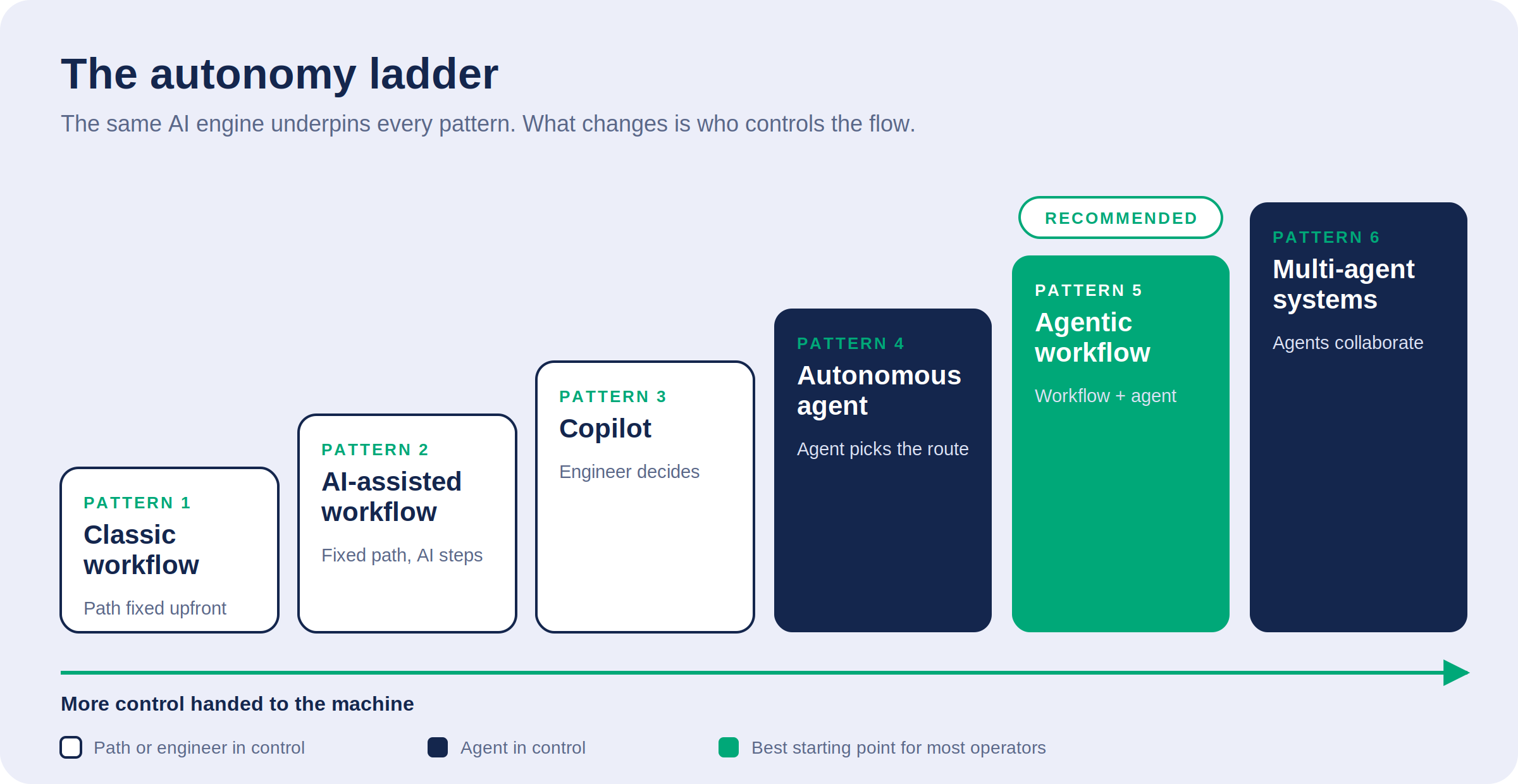
Rather than a simple choice between workflow and agent, we see a spectrum of six patterns. Each one transfers a greater degree of control from predefined logic and people to the AI system (Exhibit 1).
Pattern 1: Classic workflow automation
The sequence of steps is defined in advance, and the same input consistently produces the same output. If the process can be documented as a flowchart, it is a workflow.
Typical application: scheduled configuration backups, or a CI/CD pipeline that tests and deploys a cloud-native network function. This pattern is well suited to high-volume, predictable tasks. Its limits tend to appear when the number of exceptions and conditional branches grows faster than teams can maintain them.
Pattern 2: AI-assisted workflow
The sequence remains fixed, while AI performs the steps that require interpretation, such as reading a log, extracting data from vendor documentation or classifying an alarm. Control then returns to the workflow.
Typical application: a language model that summarises a burst of syslog messages before the standard ticketing process continues. In our view, this pattern currently accounts for much of the practical value of AI in operations. One point warrants attention: business rules can gradually migrate into prompts, where they are harder to govern.
Pattern 3: The copilot
The AI provides recommendations and the engineer makes the decision. A copilot may suggest a command, draft a configuration file or explain a Kubernetes event, and it acts only when requested.
Typical application: an assistant supporting NOC engineers during a RAN incident. This pattern is most appropriate where human judgement and accountability are essential.
Pattern 4: The autonomous agent
The organisation defines the objective and the agent determines how to achieve it. It reasons, selects tools and adjusts its approach as conditions change. Two executions of the same task may follow different paths, which is a source of both flexibility and risk.
Typical application: investigating a latency increase on a network slice by querying telemetry, reviewing recent changes and forming a hypothesis. A helpful test applies here: when the agent's instructions prescribe a fixed order of steps, a workflow is usually the more suitable design.
Pattern 5: The agentic workflow
A structured workflow embeds an agent at the points where judgement is required. It combines predictability where it is needed with autonomy where it adds value. For most operators, we believe this pattern offers the most attractive balance today.
Pattern 6: Multi-agent systems
Several specialised agents collaborate, with roles such as planning, data gathering, review and execution. These systems can address complex problems, but they are more difficult to observe and troubleshoot. They are generally better suited to organisations that have already established strong observability and governance.
For most operators, the agentic workflow provides the right balance
The approach we see working well in network operations is not full autonomy. It is a structured workflow that applies an agent selectively, at the points where judgement creates the most value.
Alarm management offers a clear illustration (Exhibit 2). The workflow ingests and de-duplicates alarms along a defined path. An agent then investigates, correlating telemetry, reviewing recent changes and proposing a likely root cause. An engineer approves any change that affects production. The workflow executes the remediation, verifies the result and closes the ticket.

The result is a system that is predictable where reliability is critical, intelligent where analysis adds value, and accountable at the point of action.
Autonomy creates value only when it is grounded in awareness
The telecom industry has considered this question for some time. TM Forum's work on autonomous networks describes autonomy as a progression of levels, and its assurance perspective highlights an important principle: automation that lacks an accurate view of network conditions can act quickly on the wrong problem.
Awareness and analysis therefore need to precede automated action. The same principle applies to AI agents. An agent that can change configuration without a reliable understanding of network state is more likely to introduce operational risk than to reduce it.
For this reason, the first question for leaders is less about how much autonomy is possible and more about what the system genuinely understands.
Effective agents are analysts first and automators second
Many agent designs treat inventory, OSS/BSS platforms, telemetry and ticket history mainly as systems to update once the analytical work is complete.
In practice, these systems are where much of the intelligence resides. They show which cells are degrading, which slices are at risk of breaching service levels, which nodes changed recently and which customers are affected. An agent without dependable access to this information is, in effect, working from assumptions.
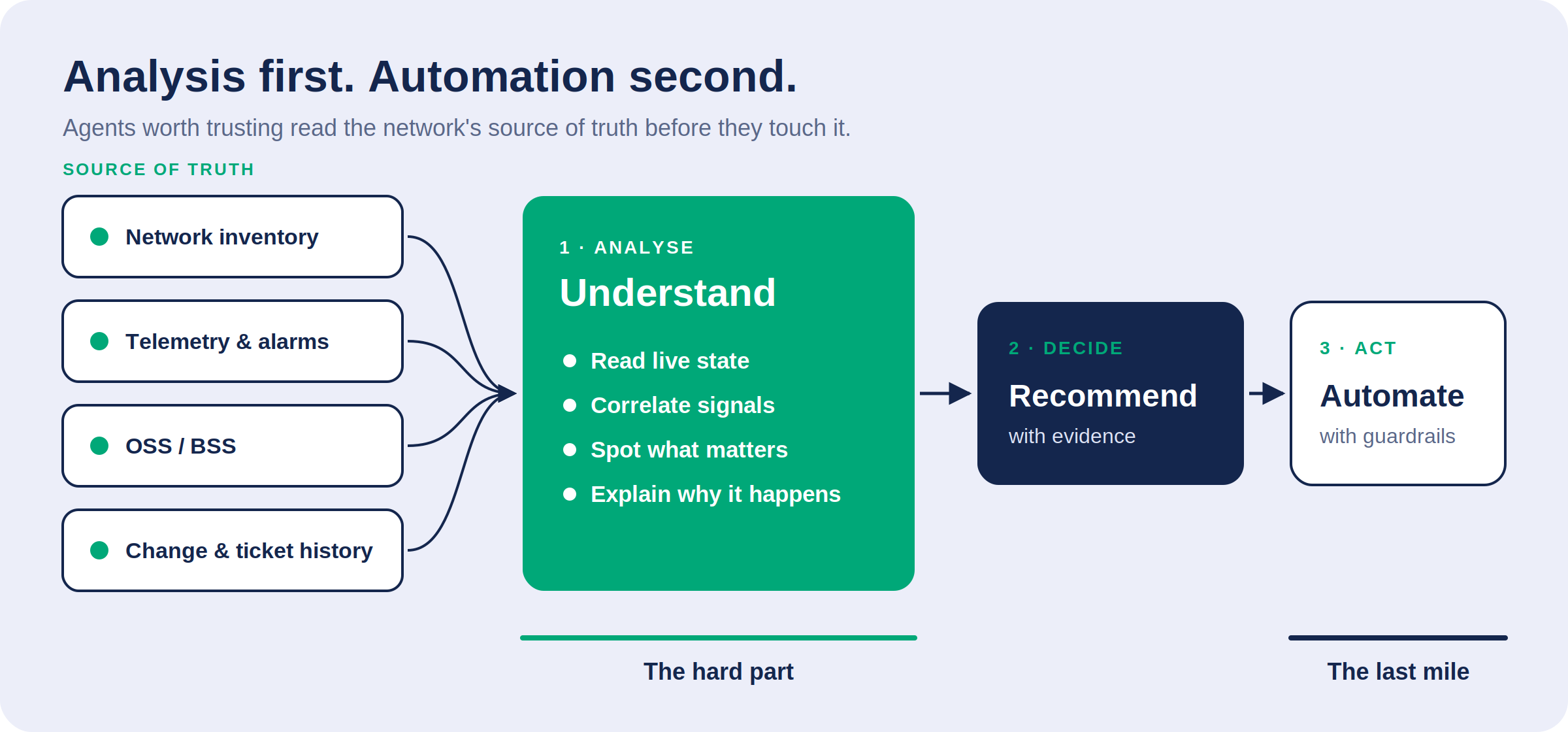
The most valuable agents follow a clear sequence (Exhibit 3). They read the source of truth, identify the patterns that matter, explain the underlying causes and only then recommend or take action. Analysis is the most demanding step; automation completes the process.
Five questions can guide leaders evaluating AI systems
- Who controls the flow? A predefined path, an engineer or the agent itself.
- Where is autonomy applied? Within a single step, on request, or across the end-to-end process.
- How does the system respond when conditions change? Workflows follow defined branches, copilots wait for direction and agents adapt. The right behaviour depends on the operational context.
- How autonomous is the system in production? Performance in a controlled demonstration may differ from performance on a live network.
- What is the system's intelligence grounded in? Live inventory and telemetry, or general knowledge alone.
Conclusion: clarity of design should precede scale of autonomy
The term "agent" will continue to describe a broad range of systems. For operators, the more useful lens is the design pattern behind it: who controls the flow, where autonomy is applied and what the system's decisions are grounded in.
Three principles emerge from this perspective. First, select the simplest pattern that delivers the required outcome, reserving greater autonomy for problems that genuinely require it. Second, ground every agent in the network's source of truth, so that analysis consistently precedes action. Third, keep people accountable at the point where changes reach production.
These principles shape how LabLabee approaches agentic AI. LabLabee is an AI multi-agent platform built for telco and enterprise teams, connecting enablement, validation and troubleshooting in a single loop grounded in real data.
Ready to give your team the hands-on edge? Explore LabLabee and start building.