Building Toward AI-Native Operations
The network operators moving fastest on AI are not just deploying models - they are building toward a different kind of operational model altogether. AI-native operations: where AI is not a tool that augments human workflows but an operational layer that handles routine decisions autonomously, escalates what genuinely requires human judgment, and becomes more capable with every interaction.
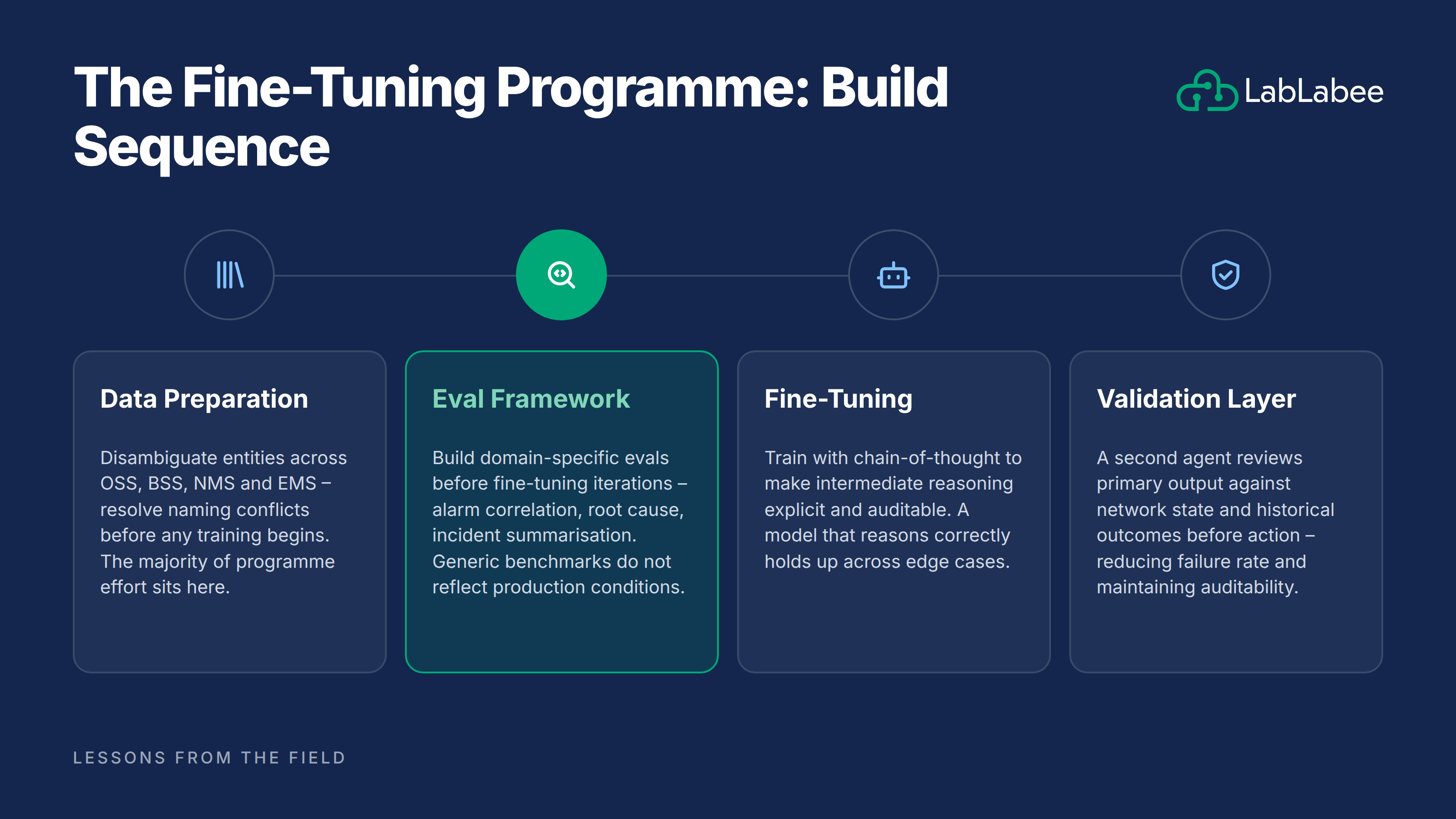
The deployments happening today are building the foundation for that transition. The question shaping how far and how fast that foundation carries them is not which model to use - it is the architecture built around the model: what the system knows, how consistently it retrieves context, and what it retains across interactions. Mastering this foundational layer is what elevates AI from isolated pilots to scalable, enterprise-grade capabilities.
Domain Intelligence: The Architecture Behind AI That Accumulates
Frontier models represent a genuine step change in general-purpose reasoning capability. For network operators, they provide an immediately accessible foundation - broad language understanding, strong inference across diverse task types, and rapid deployment against a wide range of operational use cases. The value is real and the starting point is high.
Three forces are converging to make domain-specific AI a practical and strategic choice for network operators:
- Open weight models have matured. Fine-tuning on domain data is now technically accessible and economically viable — no longer a research project.
- Inferencing at scale is an architectural decision, not an afterthought. The volume and latency demands of live network operations require an architecture designed for that load from the outset, not retrofitted to it.
- Data sovereignty requirements are reshaping where AI runs. Governing where operational data is processed and retained makes a domain-controlled model an increasingly preferred architecture over routing sensitive network data to third-party inference endpoints.
The result is a growing move toward fine-tuned models built specifically for CSP operations. But a fine-tuned model on its own is not domain intelligence. It is one component of it. The system that surrounds the model - how data is prepared and governed, how context is retrieved at inference time, what the system retains across interactions - is what determines whether the model's domain knowledge compounds over time or remains static.
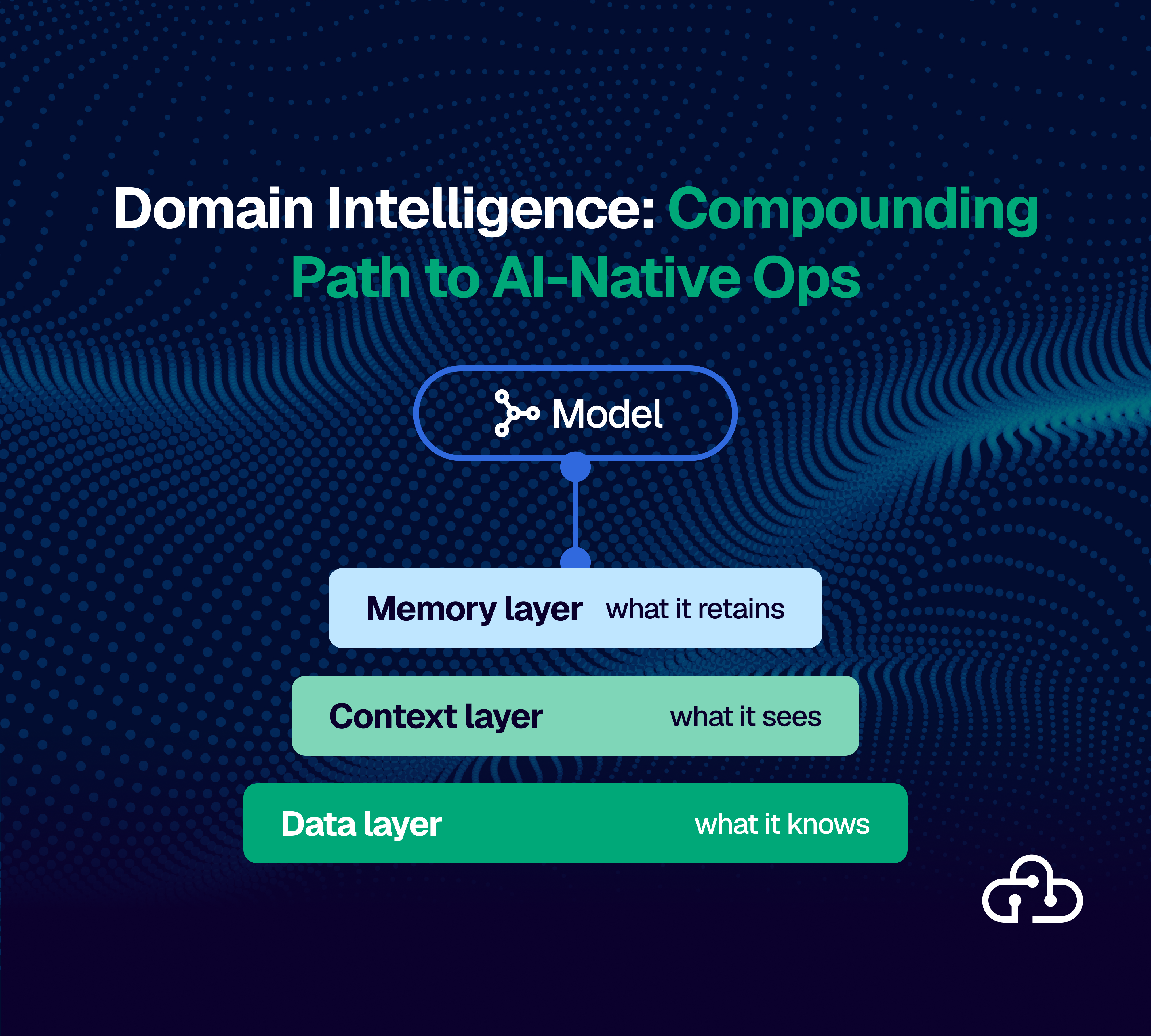
Domain intelligence is that system — the architecture that sits beneath the model and determines what it knows, what it sees, and what it remembers:
- Data layer — the substance of what the system knows. Not data as an input but as the foundation itself.
- Context layer — what reaches the model at inference time, ensuring relevance and consistency across every use case drawing on the same foundation.
- Memory layer — what the system retains in production, building an accumulated operational understanding that grows with every interaction.
This is where compounding begins: not at the model, but in the layers around it.
Fine-Tuning in Practice: Lessons from the Field
Data preparation is the majority of the work
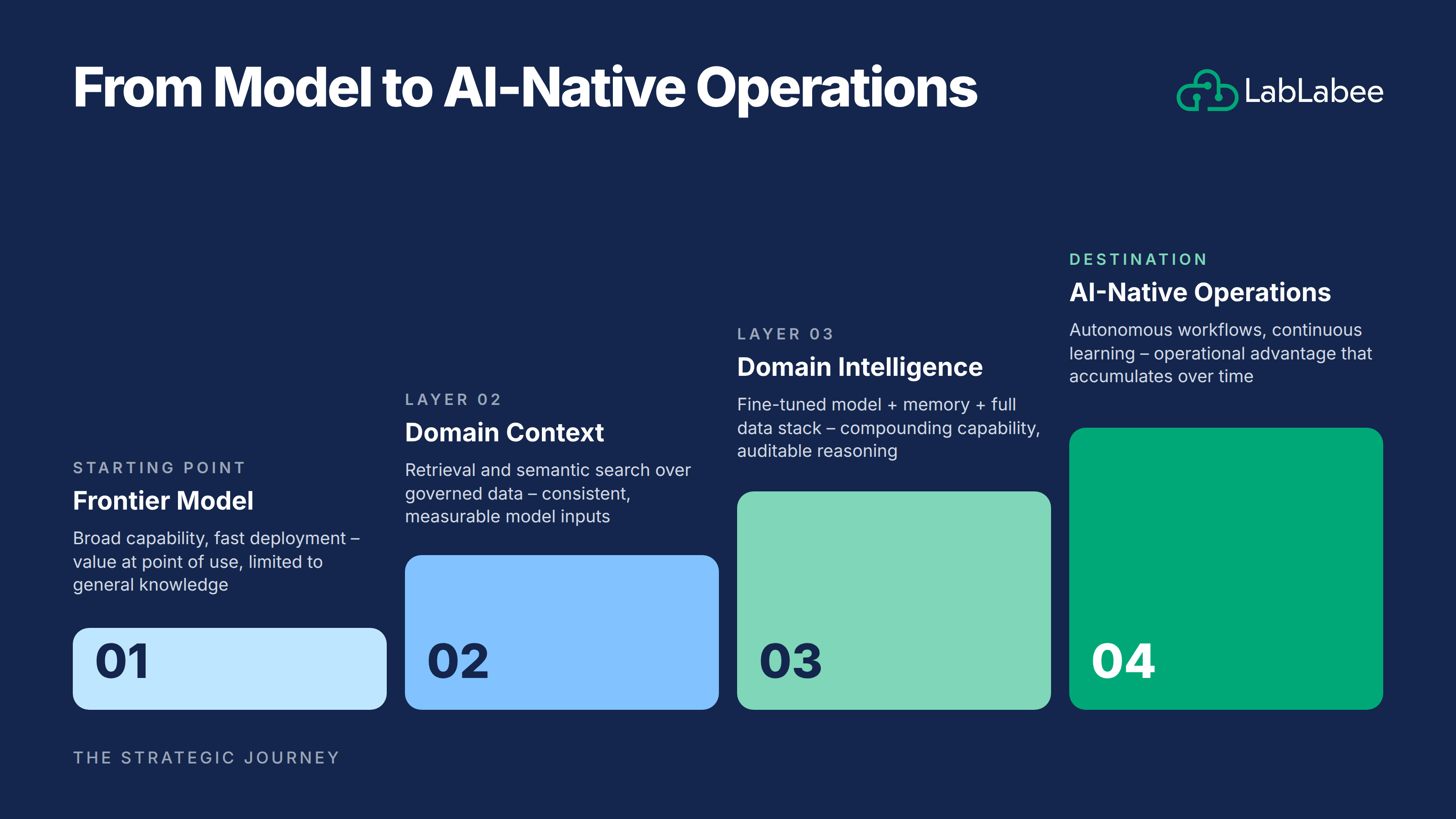
In CSP environments, the data challenge is structural. Network data originates across dozens of systems - OSS, BSS, NMS, EMS - each with its own schema, naming conventions, and definition of the same underlying entity. A network element referenced in a fault management system may carry a different identifier in the configuration database and a different label in the planning tool. We must resolve that disambiguation before any fine-tuning begins. In our experience, data preparation accounts for the majority of time and effort in a fine-tuning programme - not model selection, not training runs. In addition to cleaning and re-organizing data that’s already there, we often have to create internal datasets based on SMEs feedback and workflows.
Evals grounded in operational reality
Generic benchmarks do not reflect CSP operational conditions. The eval framework has to be built around actual tasks: alarm correlation, root cause classification, incident summarisation, configuration change assessment, and non-regression workflows. What counts as correct in a lab can be wrong in production if the model has not been evaluated against the ambiguity and noise present in live network data. Investing in domain-specific evals before fine-tuning iterations - not after - has been one of the most important drivers of improvement velocity in our work.
Reasoning and tools used matter as much as the output
For tasks like root cause analysis or change risk assessment, the reasoning trajectory is as important as the conclusion. A model that arrives at the right answer through flawed reasoning will fail on the next variant of the same problem. Working with chain-of-thought and tool call during fine-tuning - making intermediate steps explicit and evaluable - produced models that held up across edge cases and were significantly easier to audit when they did not.
Where efficiency gains are real
The use cases delivering measurable efficiency gains in the CSP market are concentrated in high-volume, high-repetition operational workflows:
- Alarm triage and correlation - reduction in manual alarm handling through filtering correlated and false-positive events before they reach operations teams
- Root cause analysis - MTTR reduction on common fault classes where the model has been trained on sufficient historical resolution data
- Change and configuration management - reduction in human review time for routine change requests, with failure rate reduction as a secondary gain
These gains are contingent on the data preparation and eval work that precedes deployment. Without it, the same models operating on uncontrolled inputs produce results that are inconsistent and unauditable.
The validation layer: where the second agent earns its value
One of the more significant efficiency gains comes not from the primary inference agent but from the validation layer - a second agent tasked with reviewing and challenging the primary agent's output before it is actioned. In network operations, this pattern is particularly valuable: a change recommendation or fault resolution proposed by the primary agent is passed to a validation agent that checks it against current network state, historical outcomes, and known risk patterns.
The practical effect is a substantial reduction in human review requirements for routine operational decisions - while maintaining auditability for cases that genuinely require it. The efficiency case for domain AI in CSP operations is well-founded. The path to realising it runs through data preparation, rigorous evals, and the architectural discipline to validate before acting.
A System That Improves With Use
When the underlying architecture is correct, domain AI exhibits a property that isolated model deployments cannot: it compounds.
A retrieval improvement propagates to every agent simultaneously. A correction to a semantic definition - what constitutes a critical event, how a network entity is classified - takes effect once and applies everywhere. The memory layer retains what worked: resolution patterns, entity relationships, operational context that would otherwise be rebuilt from scratch on every interaction.
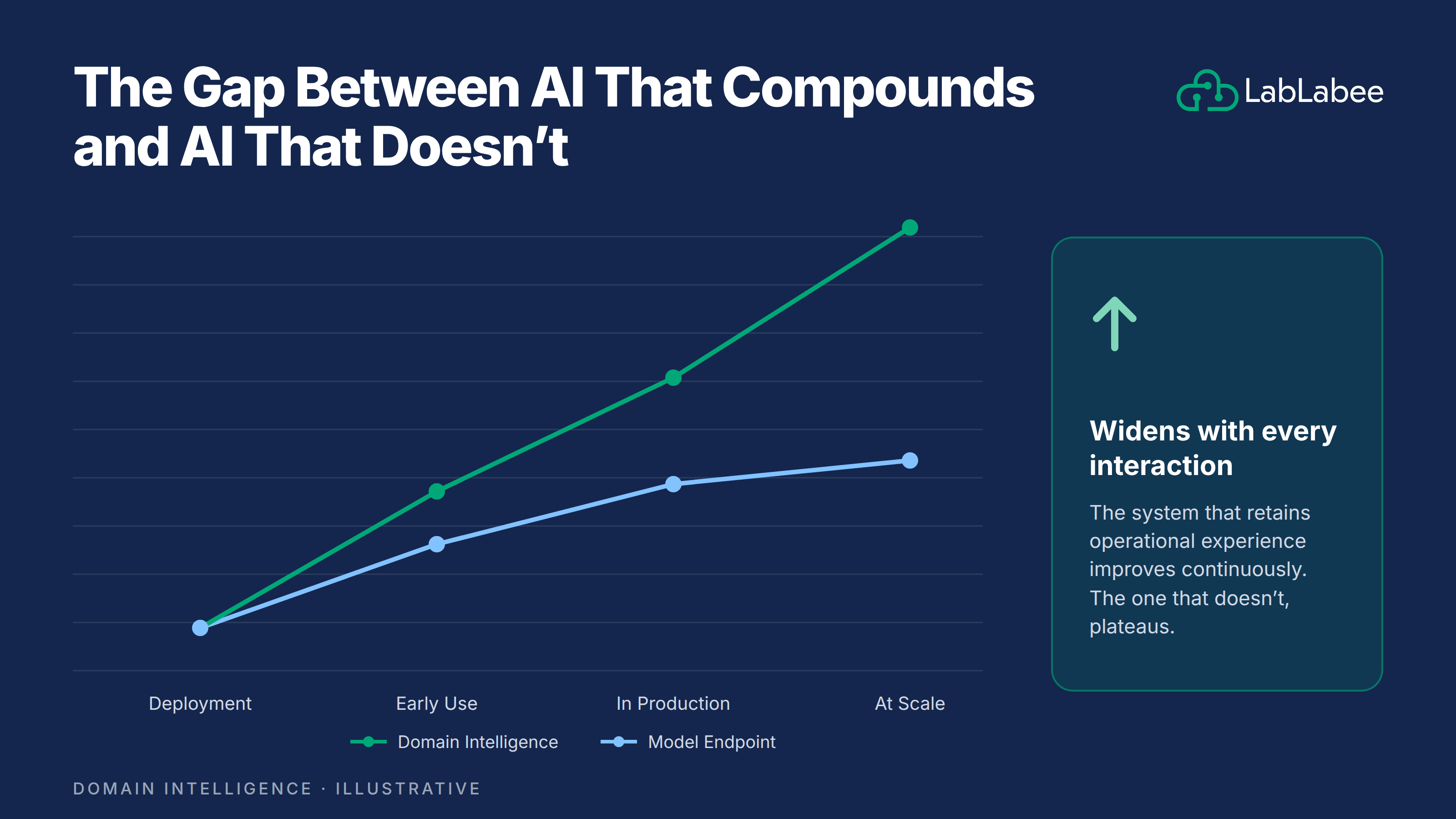
The result is a system that becomes measurably more capable with use - not because the model was retrained, but because the foundation it operates on grows richer with accumulated operational experience. Performance attribution becomes precise enough to act on. Fine-tuning cycles are grounded in clean signals. The gap between pilot performance and production performance closes rather than widens.
This is the characteristic that distinguishes domain intelligence from a well-configured model endpoint. The former is designed to improve with use; the latter typically remains dependent on its initial configuration.
The Opportunity in Network Operations
The potential efficiency gains available to CSP operators, from domain AI in network operations are significant, particularly in high-volume workflows such as alarm triage, root-cause analysis and change management.
Realising that potential depends less on having the most advanced model and more on building the data, context and validation foundations that make AI measurable, consistent and improvable.
Organisations that invest early in these foundations may develop operational context that becomes increasingly valuable over time.